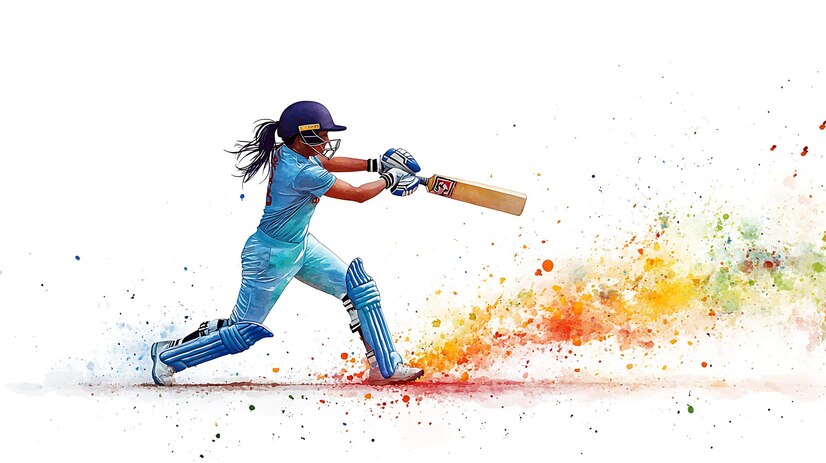
After 155 matches and 17 years in West Indies colours without a single Twenty20 International fifty to her name, Shemaine Campbelle walked off unbeaten on 90 against New Zealand in the World Cup.
The chase that shouldn’t have been chased
The defending champions had set the trap. New Zealand (ranked four places above the West Indies), posted 162 for 6. Brooke Halliday was top-scoring with 40, Izzy Gaze brisk on 39, Maddy Green unbeaten on 35 from 22 and a night that also marked Amelia Kerr’s 100th T20I. A target of 163 at a World Cup, against the holders, is the sort of total that gets people shaking their heads and declaring the winners before the seconds innings even begins.
It was Shemaine Campbelle however who refused the script. Alongside captain Hayley Matthews, who made 48 before losing her wicket, she rebuilt with the patience of someone who had been told, simply, to trust herself. “Hayley said to me, ‘keep believing in yourself and keep playing to your strengths.”
Reprieved on review when given out lbw, dropped more than once as New Zealand’s fielding frayed, she absorbed it and made it count. When she cleared the ropes twice in a single Amelia Kerr over to bring up her maiden T20I half-century, something shifted in the innings, and visibly, in her. From there she did not so much accelerate as ascend, finishing with seven fours and three sixes from 62 balls, and steering her side home at 163 for 3 with one ball to spare. It stands as the second-highest successful run chase in the history of the Women’s T20 World Cup.
Seventeen years of being almost
To understand why a wicketkeeper-batter wept on a cool English evening, you have to understand a career stretching back to 2009. She has played the format more than 150 times and ever only averaged around 15. She was statistically speaking, a steady hand who had never delivered the defining innings for the team. That is the context that turns a 90 into something larger than a 90. She is not the youngster announcing herself, like we’ve seen in the past and in the present. She is a stalwart for the team, a Guyanese veteran, deep into a long career, finally closing the gap between what she knew about herself and what the scorecard had always shown. “I just wanted to go out there and bat. I said to myself, ‘I’m going to do this for my team,’ and I did it.”
Captain Hayley Matthews, framed it perfectly, “she’s someone that plays with a lot of heart, and a lot of fight, and she has a lot of self-belief. At one point she was struggling to get the ball away, but she just stuck with it and fought with it and ended up with the score that she did, which was pretty amazing to see.”
Where she chose to look
Shemaine Campbelle moved me to tears, her demeanour is one of humility, and her actions at the end of an electrifying innings was the kind of faith that stirs you. A full-on glorifying, prayer session? Bring it on! Athletes thank a lot of people in the minutes after a win. Coaches, teammates, families, the fans back home. What made Campbelle’s moment land differently was the order of her instinct. Before the analysis, before the deflection to the team, before any of the practised order of the post-match circuit, came the line that followed Ian Bishop’s question, what did you say to the big man? Her answer, “I know God got me, and I prayed to him.”
For a player who had spent the better part of two decades waiting, faith is not a footnote to that story, it is the load-bearing wall. The prayer she referred to was not a flourish for the cameras it was, by her own account, the thing that had held her. When the breakthrough finally arrived, she did not treat it as proof of her own talent. She treated it as an answer.
There is a quiet theology in that, and it is worth sitting with. Plenty of sportspeople invoke a higher power in victory. Fewer do it in a way that so clearly reframes the achievement, not a look what I did, but look what carried me through. In a results business that prizes the individual highlight, Shemaine’s first reflex was gratitude pointed away from herself.
Before the tactics, before the team, came the prayer. “I know God got me.”
A career, and maybe a campaign, turned
Sport remembers nights like this. This innings will go down in Caribbean cricket folklore not only for its scale but for its timing. The opening statement of a World Cup, delivered against the reigning champions, by the player least expected to deliver it. For the West Indies, beating New Zealand without the likes of Stafanie Taylor and Chinelle Henry in the side hints, as Matthews put it, at a “limitless” ceiling once the full squad is whole.
For Shemaine Campbelle, the meaning is more personal. A maiden fifty became a match-winning 90. A long, patient career found its headline. Whatever the rest of this tournament holds for the West Indies, Shemaine’s choice of celebration is the part of the night that will outlast the scorecard. Especially for those who were watching, who have faithfully kept holding on, and faithfully kept showing up and believing regardless of the “scorecard” on their own lives. Shemaine Campbelle gave us that and so much more and I’m grateful to have witnessed this incredible moment.